318. Semi-infinite solenoid and super conducting disc

33 messaggi · originale su forum Olifis

Physicsguy513 set 2023, 21:00
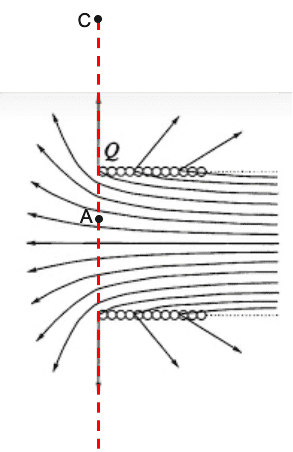
A semi-infinite solenoid with a coil radius \(r\) and a winding density \(n\) (the number of coils per unit length) is located coaxially with a circular superconducting coil of radius \(R\) so that its base is in the plane of the coil. It is known that \(r \ll R\). Initially, there was no current in the coil. The inductance of the coil is equal to \(L\). The current strength in the solenoid is slowly increased from zero to \(I\) and then maintained constant. The wires supplying current to the solenoid are arranged in such a way that their magnetic field and their interaction with other elements can be neglected. Let's direct the \(x\) axis as shown in the figure.

1. Points \(A\) and \(C\) are located in the plane of the coil at distances \(r / 3\) and \(3 r\), respectively, from the axis of symmetry of the system. Find the projections of induction \(B_{A x}\) and \(B_{C x}\) of the magnetic field generated by the solenoid at points \(A\) and \(C\), respectively.

2. FInd current strength in the coil. Which direction is it directed?

3. Find the magnitude and direction of the magnetic interaction force acting on the solenoid from the side of the coil.


Picture: https://ibb.co/R393bBJ
Tarapìa Tapioco5 set 2023, 17:57
Is the value of \(L\) needed to calculate the current in item 2?
Higgs5 set 2023, 18:13
1. Points A and C are located on the plane of the last coil of solenoid . In particular A is an internal point of solenoid at distance r/3 from the axis while C is an external point at distance 3r from the axis. Now it is clear that \(B_A\) has an unic component of B wich is parallel to x. Hence I think that \(B_{Ax}= B_A= \mu_0In\). On the contrary C as external point has a tangent component of B. If we consider an Amperian coil of radius 3r in the plane ortogonal to axis containing just the last coil of solenoid by Ampere low we obtain\(B_t(2\pi.3r)=\mu_0 I\) or \(B_t=\frac{\mu_0 I}{6\pi r}\) It is a negligible fraction of B or \(\frac{B_t}{B}=\frac {1}{6 \pi r n}\): Is it correct at this point to say \(B_{Cx} =0\)?
Tarapìa Tapioco5 set 2023, 22:34
\(1.\) Sorry, but I do not agree with @Higgs in a total way. According to my theory, the second part is correct. In a semi-infinite solenoid, a field line crossing the endmost winding is a straight line perpendicular to the axis of solenoid: it can be demonstrated and shown that for distances greater than the radius of the solenoid, the field lines are perpendicular to the axis of the solenoid, which means that the field has zero axial component at \(C\). So, \(B_{C_x} = 0\). All the steps taken by @Higgs in this regard are correct. The drawing below shows the plane of the coil as a dotted line, and points \(A\) and \(C\) approximately drawn to scale. The axial component (parallel to the axis of the solenoid) is zero at \(C\) and non-zero at \(A\).

Immagine

Unfortunately, I disagree on the first part. To begin with, an Amperian loop
in the plane ortogonal to axis containing just the last coil of solenoid
has no current cutting through its plane so the enclosed current is zero. This is consistent with the fact that the component of the field at the circumference of the Amperian loop is radial, which means that the field vector \(\textbf{B}\) and the line element \(d\textbf{s}\) are perpendicular to each other and \(\oint_{}^{}\textbf{B} \cdot d\textbf{s} = 0\). So Ampere's law in this case gives \(0 = 0\), which is not very helpful. Moreover, the equation \(B = \mu_0 n I\) works for points far away from the ends, whereas the point of interest \(A\) is on the plane of the end of the solenoid at \(x = 0\).

\(2.\) I think it's a Meissner effect situation. The supercurrent provides a counter-flux that excludes all the flux that comes out of the solenoid. Half the flux in the solenoid goes out the sides, so we have to calculate how much current is needed to generate that amount of counter-flux. Since the radius \(R\) of the solenoid is much larger than the radius \(r\) of the coil, I think it is safe to calculate the counter-flux through the end of the solenoid using the expression for the field at the center of a ring of current. According to Lenz's Law, the current induced in the loop generates a counter-flux \(\Phi_{ring}\) that opposes the external flux \(\Phi_{ext}\), which attempts to thread the loop. The net flux through the loop is equal to the difference of the external flux attempting to thread the loop and the counter-flux due to the induced current: \(\Phi_{net} = \Phi_{ext} - \Phi_{ring}\). In the case of a superconducting loop, its resistance is zero, then the opposition of the counter-flux to the external flux is complete and \(\Phi_{net}\) remains constant perpetually. So, since the total flux through the superconducting loop remains constant at \(0\) (the reason for this is that any change in flux requires a nonzero emf around the loop, which requires in infinite current, so magnetic flux through the loop cannot change), the counter-flux of the loop must be equal and opposite to the external flux. So:

\(\Phi_{net} = \Phi_{ext} - \Phi_{ring} = 0 \Rightarrow \Phi_{ext} = \Phi_{ring}\), with \(\Phi_{ext} = \frac {1}{2} \mu_0 n I \pi r^2\)

I would say that the magnetic field at the center of the loop is \(B_{ring} = \frac{\mu_0 I_{ring}}{2R}\), that produces flux \(\Phi_{ring} = \frac{\mu_0 I_{ring}}{2R} \pi r^2\) through the end of the solenoid. Since the flux through the loop must be zero:

\(\frac {1}{2} \mu_0 n I \pi r^2 = \frac{\mu_0 I_{ring}}{2R} \pi r^2 \Rightarrow n I = \frac {I_{ring}}{R} \Rightarrow I_{ring} = nRI.\)

Though, the value of self-inductance \(L\) provided by the text does not appear in this result, which is a problem.

\(3.\) If we have the supercurrent \(I_{ring}\) and the radial field \(B_r\) at the loop, we can find the force as:

\(F = I_{ring} l B_r \Rightarrow F = 2 \pi R I_{ring} B_r\).

The key for this item is finding \(B_r\) on the dotted red line (see figure above) as a function of \(r\). I don't know how to do that for large distances from the axis.

Could you post some hints about the observations I just put forward, so that I can begin to develop a real procedure?
Physicsguy516 set 2023, 1:59
Higgs ha scritto: ↑
5 set 2023, 18:13
1. Points A and C are located on the plane of the last coil of solenoid . In particular A is an internal point of solenoid at distance r/3 from the axis while C is an external point at distance 3r from the axis. Now it is clear that \(B_A\) has an unic component of B wich is parallel to x. Hence I think that \(B_{Ax}= B_A= \mu_0In\). On the contrary C as external point has a tangent component of B. If we consider an Amperian coil of radius 3r in the plane ortogonal to axis containing just the last coil of solenoid by Ampere low we obtain\(B_t(2\pi.3r)=\mu_0 I\) or \(B_t=\frac{\mu_0 I}{6\pi r}\) It is a negligible fraction of B or \(\frac{B_t}{B}=\frac {1}{6 \pi r n}\): Is it correct at this point to say \(B_{Cx} =0\)?
Your value of \(B_Ax\) is extremely close to the correct value. Your answer of \(B_Cx\) is correct!
Physicsguy516 set 2023, 2:08
Tarapìa Tapioco ha scritto: ↑
5 set 2023, 22:34
\(1.\) Sorry, but I do not agree with @Higgs in a total way. According to my theory, the second part is correct. In a semi-infinite solenoid, a field line crossing the endmost winding is a straight line perpendicular to the axis of solenoid: it can be demonstrated and shown that for distances greater than the radius of the solenoid, the field lines are perpendicular to the axis of the solenoid, which means that the field has zero axial component at \(C\). So, \(B_{C_x} = 0\). All the steps taken by @Higgs in this regard are correct. The drawing below shows the plane of the coil as a dotted line, and points \(A\) and \(C\) approximately drawn to scale. The axial component (parallel to the axis of the solenoid) is zero at \(C\) and non-zero at \(A\).

Immagine

Unfortunately, I disagree on the first part. To begin with, an Amperian loop
in the plane ortogonal to axis containing just the last coil of solenoid
has no current cutting through its plane so the enclosed current is zero. This is consistent with the fact that the component of the field at the circumference of the Amperian loop is radial, which means that the field vector \(\textbf{B}\) and the line element \(d\textbf{s}\) are perpendicular to each other and \(\oint_{}^{}\textbf{B} \cdot d\textbf{s} = 0\). So Ampere's law in this case gives \(0 = 0\), which is not very helpful. Moreover, the equation \(B = \mu_0 n I\) works for points far away from the ends, whereas the point of interest \(A\) is on the plane of the end of the solenoid at \(x = 0\).

\(2.\) I think it's a Meissner effect situation. The supercurrent provides a counter-flux that excludes all the flux that comes out of the solenoid. Half the flux in the solenoid goes out the sides, so we have to calculate how much current is needed to generate that amount of counter-flux. Since the radius \(r\) of the coil is much larger than the radius \(R\) of the solenoid, I think it is safe to calculate the counter-flux through the end of the solenoid using the expression for the field at the center of a ring of current. According to Lenz's Law, the current induced in the loop generates a counter-flux \(\Phi_{ring}\) that opposes the external flux \(\Phi_{ext}\), which attempts to thread the loop. The net flux through the loop is equal to the difference of the external flux attempting to thread the loop and the counter-flux due to the induced current: \(\Phi_{net} = \Phi_{ext} - \Phi_{ring}\). In the case of a superconducting loop, its resistance is zero, then the opposition of the counter-flux to the external flux is complete and \(\Phi_{net}\) remains constant perpetually. So, since the total flux through the superconducting loop remains constant at \(0\) (the reason for this is that any change in flux requires a nonzero emf around the loop, which requires in infinite current, so magnetic flux through the loop cannot change), the counter-flux of the loop must be equal and opposite to the external flux. So:

\(\Phi_{net} = \Phi_{ext} - \Phi_{ring} = 0 \Rightarrow \Phi_{ext} = \Phi_{ring}\), with \(\Phi_{ext} = \frac {1}{2} \mu_0 n I \pi r^2\)

I would say that the magnetic field at the center of the loop is \(B_{ring} = \frac{\mu_0 I_{ring}}{2R}\), that produces flux \(\Phi_{ring} = \frac{\mu_0 I_{ring}}{2R} \pi r^2\) through the end of the solenoid. Since the flux through the loop must be zero:

\(\frac {1}{2} \mu_0 n I \pi r^2 = \frac{\mu_0 I_{ring}}{2R} \pi r^2 \Rightarrow n I = \frac {I_{ring}}{R} \Rightarrow I_{ring} = nRI.\)

Though, the value of self-inductance \(L\) provided by the text does not appear in this result, which is a problem.

\(3.\) If we have the supercurrent \(I_{ring}\) and the radial field \(B_r\) at the loop, we can find the force as:

\(F = I_{ring} l B_r \Rightarrow F = 2 \pi R I_{ring} B_r\).

The key for this item is finding \(B_r\) on the dotted red line (see figure above) as a function of \(r\). I don't know how to do that for large distances from the axis.

Could you post some hints about the observations I just put forward, so that I can begin to develop a real procedure?
Your answer for \(B_{Cx}\) is correct. Unfortunately, your answer for \(B_{Ax}\)
is incorrect. For this part, try thinking of adding another similar solenoid to our solenoid and then try to look for symmetry in this arrangement. For part 2, your answer is incorrect. I think you are correct about your initial thoughts, since the coil is superconducting, the magnetic flux passing through it must remain constant and equal to zero. For part 3, there are 4 ways that I know of to solve this problem. You can try thinking that the force of interaction between the coil and the solenoid is directed along their common axis. Good luck!
Tarapìa Tapioco6 set 2023, 6:06
@Physicsguy51 I wanted to make it clear that mine are not answers, but only theories and observations. The value of \(B_{A_x}\) cannot be incorrect because I have not yet given it!
Tarapìa Tapioco6 set 2023, 7:06
Is \(B_{A_x} = \frac{\mu_0 n I}{2}\)? And is \(I_{ring} = \frac {\Phi_{ext}}{L} = \frac{\mu_0 \pi n I r^2}{2L}\)?
Physicsguy516 set 2023, 11:37
Tarapìa Tapioco ha scritto: ↑
6 set 2023, 7:06
Is \(B_{A_x} = \frac{\mu_0 n I}{2}\)? And is \(I_{ring} = \frac {\Phi_{ext}}{L} = \frac{\mu_0 \pi n I R^2}{2L}\)?
Both are correct. The current is in opposite direction hence I_ring will have a -ve sign.
Tarapìa Tapioco6 set 2023, 11:44
Ok, thank you very much for your diligent reply!
Higgs6 set 2023, 11:56
Yes the strength line of B in A is not parallel to the axis. We can say, considering the angle of \(\pi/2 \)for r=r/2, that \((r/2):(\pi/2)=(r/3):\alpha\) or \(\alpha = \pi/3\). Hence the proiection of \(B_A\)on the axis is \(B_{Ax}=\mu_0 I n. cos(\pi/3)= \frac{\mu_0 I n}{2}\)Now if it is correct I'll try 2. and 3.
Tarapìa Tapioco6 set 2023, 12:02
Is \(F = 2\pi R I_{ring} B_A\)?
Physicsguy516 set 2023, 12:19
Tarapìa Tapioco ha scritto: ↑
6 set 2023, 12:02
Is F = \(\frac{1}{2} \mu_0 I I_{ring} A\), where \(A\) is the cross-sectioned area?
Incorrect.
Physicsguy516 set 2023, 12:19
Higgs ha scritto: ↑
6 set 2023, 11:56
Yes the strength line of B in A is not parallel to the axis. We can say, considering the angle of \(\pi/2 \)for r=r/2, that \((r/2):(\pi/2)=(r/3):\alpha\) or \(\alpha = \pi/3\). Hence the proiection of \(B_A\)on the axis is \(B_{Ax}=\mu_0 I n. cos(\pi/3)= \frac{\mu_0 I n}{2}\)Now if it is correct I'll try 2. and 3.
Bravo! Try parts 2 and 3 now.
Tarapìa Tapioco6 set 2023, 12:27
I've modified my result. Tell me if it's correct, otherwise I will try another way.
Physicsguy516 set 2023, 12:44
Tarapìa Tapioco ha scritto: ↑
6 set 2023, 12:27
I've modified my result. Tell me if it's correct, otherwise I will try another way.
Incorrect
Tarapìa Tapioco6 set 2023, 13:05
After many attempts, I calculated it as \(F = \frac{\mu_0 I I_{ring} l}{2 \pi d}\), where \(l = 2 \pi r\) and \(d = (R-r)\). If it's correct, I'll write the unfolding, otherwise I'll think about it some more.
Physicsguy516 set 2023, 13:29
Tarapìa Tapioco ha scritto: ↑
6 set 2023, 13:05
After many attempts, I calculated it as \(F = \frac{\mu_0 I I_{ring} l}{2 \pi d}\), where \(l = 2 \pi r\) and \(d = (R-r)\). If it's correct, I'll write the unfolding, otherwise I'll think about it some more.
Incorrect, there's going to be an \(L\) in the answer too.
Tarapìa Tapioco6 set 2023, 13:33
The \(L\) would be in \(I_{ring}\), isn't it?
Physicsguy516 set 2023, 13:54
Tarapìa Tapioco ha scritto: ↑
6 set 2023, 13:33
The \(L\) would be in \(I_{ring}\), isn't it?
yeah I think, in final answer there will be a term of L
Tarapìa Tapioco6 set 2023, 14:00
Following this way, I would get \(F = \frac{\mu_0^2 n \pi r R^2 I^2}{2L (R-r)}\). Let me know, sorry for bothering you so much.
Physicsguy516 set 2023, 15:26
Tarapìa Tapioco ha scritto: ↑
6 set 2023, 14:00
Following this way, I would get \(F = \frac{\mu_0^2 n \pi r R^2 I^2}{2L (R-r)}\). Let me know, sorry for bothering you so much.
It is incorrect unfortunately, and you are not bothering me friend. In fact, I am very happy to have this discussion with you!
Give it a few more tries, I am attaching the link to the solutions. Once you give up, take a look at them (they're in russian).
https://pho.rs/p/2880/s
Tarapìa Tapioco6 set 2023, 15:29
You do not need to attach the solution. In my opinion, you can do it after assigning the relay, that is, when one of the users has answered all the questions correctly. However, thank you.
Tarapìa Tapioco6 set 2023, 15:56
\(3.\) If we have the supercurrent \(I_{ring}\) and the radial field \(B_r\) at the loop, we can find the force as:

\(F = I_{ring} l B_r \Rightarrow F = 2 \pi R I_{ring} B_r\).

The key for this item is finding \(B_r\) on the dotted red line (see figure above) as a function of \(r\). I don't know how to do that for large distances from the axis.


I am very convinced from the beginning that this is the correct answer. As already mentioned, I have to find a way to calculate \(B_r\).

Could you provide some very little information about the 4 methods you are talking about to solve this point? Of course, you don't need to say what they are, I just need to know what they are roughly hinged on.
Tarapìa Tapioco6 set 2023, 17:08
Excuse me. Is the result \(F = \frac{\mu_0^2 \pi^2 n^2 I^2 r^4}{4RL}\)? If this is not it, I really don't know which other way I should go...
Higgs6 set 2023, 18:39
2. It is well known that the flow of B across a coil of induction L and with a current i is \(\Phi= Li\). This flow must be opposite to that generated by solenoid whose B we have seen to be \(\frac {\mu_0 In}{2}\). Hence the flow caming from solenoid is \(\Phi_s= \frac{\mu_0 I n}{2}.\pi r^2\) Taking \(\Phi = -\Phi_s\) we obtain for the current in super conductig coil \(i=\frac{\mu_0\pi r^2nI }{2L} \)To morrow I'll try 3.
Tarapìa Tapioco6 set 2023, 19:44
Physicsguy51 ha scritto: ↑
3 set 2023, 21:00
A semi-infinite solenoid with a coil radius \(r\) and a winding density \(n\) (the number of coils per unit length) is located coaxially with a circular superconducting coil of radius \(R\) so that its base is in the plane of the coil. It is known that \(r \ll R\). Initially, there was no current in the coil. The inductance of the coil is equal to \(L\). The current strength in the solenoid is slowly increased from zero to \(I\) and then maintained constant. The wires supplying current to the solenoid are arranged in such a way that their magnetic field and their interaction with other elements can be neglected. Let's direct the \(x\) axis as shown in the figure.

1. Points \(A\) and \(C\) are located in the plane of the coil at distances \(r / 3\) and \(3 r\), respectively, from the axis of symmetry of the system. Find the projections of induction \(B_{A x}\) and \(B_{C x}\) of the magnetic field generated by the solenoid at points \(A\) and \(C\), respectively.

2. FInd current strength in the coil. Which direction is it directed?

3. Find the magnitude and direction of the magnetic interaction force acting on the solenoid from the side of the coil.


Picture: https://ibb.co/R393bBJ
\(1.\) Consider a generical point \(P\) at the end face of the semi-infinite solenoid. If the magnetic field strength at point P is denoted by \(B_1\), then, using superposition, a symmetrically placed second coil, as shown in Figure below, would also produce a field of strength \(B_2 = B_1 = B_{\text{end}}\).

[immagine non più disponibile]

Since the magnetic field at the centre of the solenoid, resultant magnitude of the superimposed fields, is clearly \(\displaystyle B_{\text{tot}} = B_{\text{inside}} = B_0 = \mu_0 n I\), it follows that:

\(\displaystyle B_{\text{tot}} = B_1 + B_2\) \(\displaystyle \Rightarrow\) \(B_0 = B_1 + B_1\) \(\Rightarrow\) \(\displaystyle B_0 = 2 B_1\) \(\Rightarrow\) \(\displaystyle B_1 = \frac{B_0}{2} = \frac{\mu_0 n I}{2}\) \(\Rightarrow\) \(\displaystyle B_{\text{end}} = \frac{B_{\text{inside}}}{2} = \frac{\mu_0 n I}{2}\).

So, this argument shows that the axial component of the field, at any point on the end face is exactly \(\displaystyle \frac{B_0}{2}\), where \(B\) is the (uniform) field throughout the inside the corresponding infinite solenoid. This is true because adding another semi-infinite solenoid simply doubles the axial field at any point on the end face, and cancels the radial field, resulting in a purely axial field.

Similar reasoning shows that the horizontal component of the magnetic field vector through \(P\) is \(\frac{B_0}{2}\); this would be true for any \(P\) whose distance from the axis is less than the radius \(R\) of the solenoid (see Figure below).

[immagine non più disponibile]

The drawing below shows the plane of the coil as a dotted line, and point \(A\) and \(C\) approximately drawn to scale.
Immagine

The axial component (parallel to the axis of the solenoid) is non-zero at \(A\) because it's inside the solenoid and off the axis. Moreover, it can be noticed that the point of interest \(A\) is on the plane of the end of the solenoid at \(x = 0\), so we expect that:

\(\displaystyle \boxed{B_{A_x} = \frac{\mu_0 n I}{2}}\).

To conferm it analitically, it can be considered how the magnetic field vector tips from zero to \(\displaystyle \frac{\pi}{2}\) as the axial distance changes from \(0\) to \(r\) on the red dotted line. So, the angle \(\theta\) between the vector \(\overrightarrow{B_A}\) and the perpendicular to the axis of symmetry is, keeping the ratio constant:

\(\displaystyle \frac{r}{\frac{\pi}{2}} = \frac{\frac{r}{3}}{\theta}\) \(\Rightarrow\) \(\displaystyle \theta = \frac{\frac{\pi}{2}}{r}\frac{r}{3} = \frac{\pi}{6}\).

Since point \(A\) is inside the solenoid, we have:

\(\displaystyle B_{A_x} = B_0 \sin \theta\) \(\Rightarrow\) \(\displaystyle B_{A_x} = {\mu_0 n I} \sin \bigg(\frac{\pi}{6}\bigg)\) \(\Rightarrow\) \(\displaystyle \color{Red} \boxed{\color{Black}B_{A_x} = \frac{\mu_0 n I}{2}}\).


Now, it can be shown that in a semi-infinite solenoid (such as the one shown in Figure below), a field line crossing the endmost winding is a straight line perpendicular to the axis of solenoid: it can be demonstrated that for distances greater than the radius \(R\) of the solenoid, the field lines are perpendicular to the axis of the solenoid, which means that the field has zero axial component at \(C\), which is outside the solenoid and off the axis, as we can see from the drawing above.

[immagine non più disponibile]

Consider the figures above and below. The field line \(FGH\), which passes through the very end of the winding, is a straight line from \(G\) out to infinity. Let’s assume (in search of a contradiction) that there exists a field line that crosses the line \(GH\) with a vertical component, as shown in Figure (a) below. Imagine flipping the solenoid upside down to obtain the situation in Figure (b), and then reversing the direction of the current (so that it now has the same direction as in Figure (a)) to obtain the situation in Figure (c). Note that the field at the given point on the line \(GH\) has a downward component in both figures (a) and (c) (or upward in both, if we had initially drawn it upward). Now join the two semi-infinite solenoids in figures (a) and (c) end to end, thereby creating an infinite solenoid. By superposition, the fields simply add, so we end up with a downward component at the given point along \(GH\). But this is a contradiction, because we know that the field of an infinite solenoid is zero outside the solenoid. We conclude that the field due to the semi-infinite solenoid at the given point must have had zero vertical component \(x\). In other words, it was horizontal, as we wanted to show. So, \(\displaystyle \color{Red} \boxed{\color{Black}B_{C_x} = 0}\).

[immagine non più disponibile]

The arguments used in point \(1.\) lead to more general statements about the field of a semi-infinite solenoid. Consider two points \(P\) and \(P'\), symmetrically located with respect to the end plane, as shown in Figure below. The fields \(\textbf{B}\) and \(\textbf{B'}\) are related as follows:

[immagine non più disponibile]

The radial components of \(\textbf{B}\) and \(\textbf{B'}\) are equal. The sum of the axial components of \(\textbf{B}\) and \(\textbf{B'}\) is equal to \(B_0\) if \(P\) lies inside the solenoid, or to zero if \(P\) lies outside the solenoid (that is, above the top “edge” of the solenoid in the figure). The conclusions of item \(1.\) follow in the special case where \(P\) and \(P'\) coincide.


\(2.\) The current strength in the coil is a manifestation of a Meissner effect situation. The supercurrent provides a counter-flux that excludes all the flux that comes out of the solenoid. As seen in point \(1.\), half the flux in the solenoid goes out the sides, so we have to calculate how much current is needed to generate that amount of counter-flux. According to Lenz's Law, the current induced in the loop generates a counter-flux \(\Phi_{\text{ring}}\) from the self-inductance \(L\) of the loop that opposes the external flux \(\Phi_{\text{ext}}\), which attempts to thread the loop. The net flux through the loop is equal to the sum of the external flux attempting to thread the loop and the counter-flux due to the induced current: \(\displaystyle \Phi_{\text{net}} = \Phi_{\text{ext}} + \Phi_{\text{ring}}\). In the case of a superconducting loop, its resistance is zero, then the opposition of the counter-flux to the external flux is complete and \(\Phi_{\text{net}}\) remains constant perpetually; if it could change, the induced voltage would produce an infinitely large current. So, since the total flux through the superconducting loop remains constant at \(0\) (the reason for this is that any change in flux requires a nonzero emf around the loop, which requires in infinite current, so magnetic flux through the loop cannot change), the counter-flux of the loop must be equal and opposite to the external flux. So:

\(\displaystyle \Phi_{\text{net}} = \Phi_{\text{ext}} + \Phi_{\text{ring}} = 0 \Rightarrow \Phi_{\text{ext}} = - \Phi_{\text{ring}}\), with

\(\displaystyle \Phi_{\text{ext}} = B_{\text{end}} \cdot S\), where \(\displaystyle B_{\text{end}} = \frac{\mu_0 n I}{2}\) and \(\displaystyle S = \pi r^2\). So: \(\displaystyle \Phi_{\text{ext}} = \frac {1}{2} \mu_0 n I \pi r^2\).

Counter-flux, that is flux due to self-inductance \(L\) of the loop, is: \(\displaystyle \Phi_{\text{ring}} = LI_{\text{ring}}\).

By equating the two expressions:

\(\displaystyle \Phi_{\text{ext}} = \frac {1}{2} \mu_0 n I \pi r^2 = - LI_{\text{ring}}\) \(\Rightarrow\) \(\displaystyle I_{\text{ring}} = - \frac{\frac {1}{2} \mu_0 n I \pi r^2}{L}\) \(\Rightarrow\) \(\displaystyle \color{Red} \boxed {\color{Black} I_{\text{ring}} = - \frac{\mu_0 n I \pi r^2}{2L}}\)

The induced electromotive force with different polarities induces a current whose magnetic field opposes the change in magnetic flux through the loop in order to ensure that the original flux is maintained through the loop when current flows in it. That's only how the negative sign in the equation came into being. So, the current in the coil is directed in such a way that it opposes the change in magnetic flux through the coil due to the increasing current in the solenoid. This is according to Lenz’s law, which states that an induced current always flows in a direction that creates a magnetic field that opposes the change in magnetic flux that caused it. In this case, since the magnetic field of the solenoid is pointing along the positive x-axis, the induced current in the coil must create a magnetic field that points along the negative x-axis. Therefore, using the right-hand rule, we can conclude that the current in the coil is directed clockwise when viewed from above.

\(3.\) Consider the small circular current loop of radius \(r\) placed in the magnetic field of the semi-infinite solenoid of radius \(R\). We want to find the force on the solenoid caused by the current ring. Because of the radial component of the field, \(B_R\), there is a net force on the solenoid as a whole. It arises because the field \(B\) has an outward component \(B_R\) everywhere around the ring, whereas the vertical component \(B_x\) produces a force in the horizontal plane that simply stretches or compresses the solenoid – negligibly, assuming it is fairly rigid. Therefore, if the current flows in the direction indicated, each element of the loop, \(dl\), must be experiencing a downward force of magnitude \(\displaystyle I B_R dl\). If \(B_R\) has the same magnitude at all points on the ring, as it must in the symmetrically spreading field assumed, the total downward force will have the magnitude:

\(\displaystyle \boxed{F = - l I_{\text{ring}} B_R}\), where \(\displaystyle l = 2 \pi R\) is the length of the solenoid, taken as a circumference, and \(B_R\) is the radial field. This expression has a negative sign because the force is repulsive and directed along the negative x-axis.
According to Gauss's Theorem for the magnetic field, we have that the divergence of \(\displaystyle \textbf{B}\) is equal to \(0\): the total magnetic field flux through a closed surface non-secanting the solenoid is zero. Applying Gauss's Theorem to a spherical collinear distribution to the solenoid with radius \(R\) and centered on the center of the base of the multiple-winding coil, the total magnetic field across that surface is given by the difference between the flux \(\displaystyle \Phi_0 = \Phi_{\text{inside}}\) of the magnetic field \(\displaystyle B_0 = B_{\text{inside}} = \mu_0 nI\) at the centre of the sphere-solenoid and the flux \(\Phi_R\) of the radial magnetic field \(B_R\) through the coil.
The flux \(\Phi_0\) is given by: \(\displaystyle \Phi_0 = B_0 S_{\text{circle}}\), where \(\displaystyle S_{\text{circle}} = \pi r^2\) is the surface of the superconducting loop. So: \(\displaystyle \Phi_0 = \mu_0 n \pi I r^2\).
The flux \(\Phi_R\) is given by: \(\displaystyle \Phi_R = B_R S_{\text{sphere}}\), where \(\displaystyle S_{\text{sphere}} = 4 \pi R^2\) is the surface of the sphere-solenoid. So: \(\displaystyle \Phi_R = B_R \cdot 4 \pi R^2\).

So, we obtain:
\(\displaystyle \nabla \cdot \textbf{B}= 0\) \(\Rightarrow\) \(\displaystyle \Phi_{\text{tot}} = 0\) \(\Rightarrow\) \(\displaystyle \Phi_0 - \Phi_R = 0\) \(\Rightarrow\) \(\displaystyle \Phi_0 = \Phi_R\) \(\Rightarrow\) \(\displaystyle \mu_0 n \pi I r^2 = B_R \cdot 4 \pi R^2\) \(\Rightarrow\) \(\displaystyle \boxed{B_R = \frac{\mu_0 n I r^2}{4 R^2}}\).

Substituting into the first expression for \(F\):

\(\displaystyle F = - l I_{\text{ring}} B_R \) \(\Rightarrow\) \(\displaystyle F = - 2 \pi R \frac{\mu_0 n I \pi r^2}{2L} \frac{\mu_0 n I r^2}{4 R^2} = - \frac{\mu_0^2 n^2 \pi^2 I^2 r^4}{4RL}\) \(\Rightarrow\) \(\displaystyle \color {Red} \boxed {\color {Black} F = - \frac{1}{RL} \bigg(\frac{\mu_0 n \pi I r^2}{2}\bigg)^2}\).
Physicsguy516 set 2023, 19:57
Tarapìa Tapioco ha scritto: ↑
6 set 2023, 17:08
Excuse me. Is the result \(F = \frac{\mu_0^2 \pi^2 n^2 I^2 r^4}{4RL}\)? If this is not it, I really don't know which other way I should go...
Correct! Amazing
Physicsguy516 set 2023, 19:58
Tarapìa Tapioco ha scritto: ↑
6 set 2023, 19:44
\(1.\) Consider a generical point \(P\) at the end face of the semi-infinite solenoid. If the magnetic field strength at point P is denoted by \(B_1\), then, using superposition, a symmetrically placed second coil, as shown in Figure below, would also produce a field of strength \(B_2 = B_1 = B_{end}\).

[immagine non più disponibile]

Since the magnetic field at the centre of the solenoid, resultant magnitude of the superimposed fields, is clearly \(\displaystyle B_{tot} = B_{inside} = B_0 = \mu_0 n I\), it follows that:

\(\displaystyle B_{tot} = B_1 + B_2\) \(\displaystyle \Rightarrow\) \(B_0 = B_1 + B_1\) \(\Rightarrow\) \(\displaystyle B_0 = 2 B_1\) \(\Rightarrow\) \(\displaystyle B_1 = \frac{B_0}{2} = \frac{\mu_0 n I}{2}\) \(\Rightarrow\) \(\displaystyle B_{end} = \frac{B_{inside}}{2} = \frac{\mu_0 n I}{2}\).

So, this argument shows that the axial component of the field, at any point on the end face is exactly \(\displaystyle \frac{B_0}{2}\), where \(B\) is the (uniform) field throughout the inside the corresponding infinite solenoid. This is true because adding another semi-infinite solenoid simply doubles the axial field at any point on the end face, and cancels the radial field, resulting in a purely axial field.

Similar reasoning shows that the horizontal component of the magnetic field vector through \(P\) is \(\frac{B_0}{2}\); this would be true for any \(P\) whose distance from the axis is less than the radius \(R\) of the solenoid (see Figure below).

[immagine non più disponibile]

The drawing below shows the plane of the coil as a dotted line, and point \(A\) and \(C\) approximately drawn to scale.

Immagine

The axial component (parallel to the axis of the solenoid) is non-zero at \(A\) because it's inside the solenoid and off the axis. Moreover, it can be noticed that the point of interest \(A\)is on the plane of the end of the solenoid at \(x = 0\), so we expect that:

\(\displaystyle \boxed{B_{A_x} = \frac{\mu_0 n I}{2}}\).

To conferm it analitically, it can be considered how the magnetic field vector tips from zero to \frac{\pi}{2} as the axial distance changes from \(0\) to \(r\) on the red dotted line. So, the angle \theta between the vector \(\overrightarrow{B_A}\) and the perpendicular to the axis of symmetry is, keeping the ratio constant:

\(\displaystyle \frac{r}{\frac{\pi}{2}} = \frac{\frac{r}{3}}{\theta}\) \(\Rightarrow\) \(\displaystyle \theta = \frac{\frac{\pi}{2}}{r}\frac{r}{3} = \frac{\pi}{6}\).

Since point \(A\) is inside the solenoid, we have:

\(\displaystyle B_{A_x} = B_0 sin \theta\) \(\Rightarrow\) \(\displaystyle B_{A_x} = \frac{\mu_0 n I} sin (\frac{\pi}{6})\) \(\Rightarrow\) \(\displaystyle \color{Red} \boxed{\color{Black}B_{A_x} = \frac{\mu_0 n I}{2}}\).


Now, it can be shown that in a semi-infinite solenoid (such as the one shown in Figure below), a field line crossing the endmost winding is a straight line perpendicular to the axis of solenoid: it can be demonstrated that for distances greater than the radius \(R\) of the solenoid, the field lines are perpendicular to the axis of the solenoid, which means that the field has zero axial component at C, which is outside the solenoid and off the axis, as we can see from the drawing above.

[immagine non più disponibile]

Consider the figures above and below. The field line FGH, which passes through the very end of the winding,is a straight line from G out to infinity. Let’s assume (in search of a contradiction) that there exists a field line that crosses the line GH with a vertical component, as shown in Figure (a) below. Imagine flipping the solenoid upside down to obtain the situation in Figure (b), and then reversing the direction of the current (so that it now has the same direction as in Figure (a)) to obtain the situation in Figure (c). Note that the field at the given point on the line GH has a downward component in both figures (a) and (c) (or upward in both, if we had initially drawn it upward). Now join the two semi-infinite solenoids in figures (a) and (c) end to end, thereby creating an infinite solenoid. By superposition, the fields simply add, so we end up with a downward component at the given point along GH. But this is a contradiction, because we know that the field of an infinite solenoid is zero outside the solenoid. We conclude that the field due to the semi-infinite solenoid at the given point must have had zero vertical component \(x\). In other words, it was horizontal, as we wanted to show. So, \(\displaystyle \color{Red} \boxed{\color{Black}B_{C_x} = 0}\).

[immagine non più disponibile]

The arguments used in point \(1.\) lead to more general statements about the field of a semi-infinite solenoid. Consider two points \(P\) and \(P'\), symmetrically located with respect to the end plane, as shown in Figure below. The fields \(\textbf{B}\) and \(\textbf{B'}\) are related as follows:

[immagine non più disponibile]

The radial components of \(\textbf{B}\) and \(\textbf{B'}\) are equal. The sum of the axial components of \(\textbf{B}\) and \(\textbf{B'}\) is equal to \(B_0\) if \(P\) lies inside the solenoid, or to zero if \(P\) lies outside the solenoid (that is, above the top “edge” of the solenoid in the figure). The conclusions of item \(1.\) follow in the special case where \(P\) and \(P'\) coincide.


2. The current strength in the coil is a manifestation of a Meissner effect situation. The supercurrent provides a counter-flux that excludes all the flux that comes out of the solenoid. As seen in point \(1.\), half the flux in the solenoid goes out the sides, so we have to calculate how much current is needed to generate that amount of counter-flux. According to Lenz's Law, the current induced in the loop generates a counter-flux \(\Phi_{ring}\) from the self-inductance \(L\) of the loop that opposes the external flux \(\Phi_{ext}\), which attempts to thread the loop. The net flux through the loop is equal to the difference of the external flux attempting to thread the loop and the counter-flux due to the induced current: \(\displaystyle \Phi_{net} = \Phi_{ext} + \Phi_{ring}\). In the case of a superconducting loop, its resistance is zero, then the opposition of the counter-flux to the external flux is complete and \(\Phi_{net}\) remains constant perpetually; if it could change, the induced voltage would produce an infinitely large current. So, since the total flux through the superconducting loop remains constant at \(0\) (the reason for this is that any change in flux requires a nonzero emf around the loop, which requires in infinite current, so magnetic flux through the loop cannot change), the counter-flux of the loop must be equal and opposite to the external flux. So:

\(\displaystyle \Phi_{net} = \Phi_{ext} - \Phi_{ring} = 0 \Rightarrow \Phi_{ext} = \Phi_{ring}\), with

\(\displaystyle \Phi_{ext} = B_{end} \cdot S\), where \(\displaystyle B_{end} = frac{\mu_0 n I}{2}\) and \(\displaystyle S = \pi r^2\). So: \(\displaystyle \Phi_{ext} = \frac {1}{2} \mu_0 n I \pi r^2\).

Counter-flux, that is flux due to self-inductance \(L\) of the loop, is: \(\displaystyle \Phi_{ring} = LI_{ring}\).

By equating the two expressions:

\(\displaystyle \Phi_{ext} = \frac {1}{2} \mu_0 n I \pi r^2 = LI_{ring}\) \(\Rightarrow\) \(\displaystyle I_{ring} = - \frac{\frac {1}{2} \mu_0 n I \pi r^2}{L}\) \(\Rightarrow\) \(\displaystyle \color{Red} \boxed {\color{Black} I_{ring} = \frac{\mu_0 n I \pi r^2}{2L}}\)

The induced electromotive force with different polarities induces a current whose magnetic field opposes the change in magnetic flux through the loop in order to ensure that the original flux is maintained through the loop when current flows in it. That's only how the negative sign in the equation came into being. So, the current in the coil is directed in such a way that it opposes the change in magnetic flux through the coil due to the increasing current in the solenoid. This is according to Lenz’s law, which states that an induced current always flows in a direction that creates a magnetic field that opposes the change in magnetic flux that caused it. In this case, since the magnetic field of the solenoid is pointing along the positive x-axis, the induced current in the coil must create a magnetic field that points along the negative x-axis. Therefore, using the right-hand rule, we can conclude that the current in the coil is directed clockwise when viewed from above.

\(3.\) Consider the small circular current loop of radius \(r\) placed in the magnetic field of the semi-infinite solenoid of radius \(R\). We want to find the force on the solenoid caused by the current ring. Because of the radial component of the field, \(B_R\), there is a net force on the solenoid as a whole. It arises because the field \(B\)has an outward component \(B_R\) everywhere around the ring, whereas the vertical component \(B_x\) produces a force in the horizontal plane that simply stretches or compresses the solenoid – negligibly, assuming it is fairly rigid. Therefore, if the current flows in the direction indicated, each element of the loop, \(dl\), must be experiencing a downward force of magnitude \(\displaystyle I B_R dl\). If \(B_R\) has the same magnitude at all points on the ring, as it must in the symmetrically spreading field assumed, the total downward force will have the magnitude:

\(\displaystyle \boxed{F = - l I_{ring} B_R}\), where \(\displaystyle l = 2 \pi R\) is the length of the solenoid, taken as a circumference, and \(B_R\) is the radial field. This expression has a negative sign because the force is repulsive and directed along the negative x-axis.
According to Gauss's Theorem for the magnetic field, we have that the divergence of \(\displaystyle \textbf{B}\) is equal to \(0\): the total magnetic field flux through a closed surface non-secanting the solenoid is zero. Applying Gauss's Theorem to a spherical collinear distribution to the solenoid with radius \(R\) and centered on the center of the base of the multiple-winding coil, the total magnetic field across that surface is given by the difference between the flux \(\displaystyle \Phi_0 = \Phi_{inside}\) of the magnetic field \(\displaystyle B_0 = B_{inside} = \mu_0 nI\) at the centre of the sphere-solenoid and the flux \(\Phi_R\) of the radial magnetic field \(B_R\) through the coil.
The flux \(\Phi_0\) is given by: \(\displaystyle \Phi_0 = B_0 S_{circle}\), where \(\displaystyle S_{circle} = \pi r^2\) is the surface of the superconducting loop. So: \(\displaystyle \Phi_0 = \mu_0 n \pi I r^2\).
The flux \(\Phi_R\) is given by: \(\displaystyle \Phi_R = B_R S_{sphere}\), where \(\displaystyle S_{sphere} = 4 \pi R^2\) is the surface of the sphere-solenoid. So: \(\displaystyle \Phi_R = B_R \cdot 4 \pi R^2\).

So, we obtain:
\(\displaystyle \nabla \cdot \textbf{B}= 0\) \(\Rightarrow\) \(\displaystyle \Phi_{tot} = 0\) \(\Rightarrow\) \(\displaystyle \Phi_0 - \Phi_R = 0\) \(\Rightarrow\) \(\displaystyle \Phi_0 = \Phi_R\) \(\Rightarrow\) \(\displaystyle \mu_0 n \pi I r^2 = B_R \cdot 4 \pi R^2\) \(\Rightarrow\) \(\displaystyle \boxed{B_R = \frac{\mu_0 n I r^2}{4 R^2}}\).

Substituting into the first expression for \(F\):

\(\displaystyle F = - l I_{ring} B_R \) \(\Rightarrow\) \(\displaystyle F = - 2 \pi R \frac{\mu_0 n I \pi r^2}{2L} \frac{\mu_0 n I r^2}{4 R^2} = - \frac{\mu_0^2 n^2 \pi^2 I^2 r^4}{4RL}\) \(\Rightarrow\) \(\displaystyle \color {Red} \boxed {\color {Black} F = - \frac{1}{RL} \bigg(\frac{\mu_0 n \pi I r^2}{2}\bigg)^2}\).
Brilliant! Relay goes to you
Physicsguy516 set 2023, 19:58
So, did you find the problem challenging? Also, let me know are you a student or a professor?
Tarapìa Tapioco6 set 2023, 20:09
Thanks. I found the problem not so challenging, but nice and striking (like all the others you proposed). I had understood the general physical model and I had figured out how to solve the two points, but I was stuck on the calculation of \(B_R\). Therefore, I tried other ways, always getting the result of \(F\) wrong.
Obviously, I'm a student, I'm 19. What about you?
Physicsguy517 set 2023, 6:22
Tarapìa Tapioco ha scritto: ↑
6 set 2023, 20:09
Thanks. I found the problem not so challenging, but nice and striking (like all the others you proposed). I had understood the general physical model and I had figured out how to solve the two points, but I was stuck on the calculation of \(B_R\). Therefore, I tried other ways, always getting the result of \(F\) wrong.
Obviously, I'm a student, I'm 19. What about you?
I'm a student too. I'm in last year of high school
Higgs7 set 2023, 10:22
Dal momento che uno può dire quello che vuole nel forum (con le ovvie eccezioni delle offese o quant'altro) tengo a sottolineare che personalmente non riesco a credere che Physicsguy51 e Tarapia Tapioco, siano come me, solo studenti dell'ultimo anno di liceo. D'altra parte stando ai si dice non sarebbero né i primi né gli ultimi....ma quelli come me possono imparare ugualmente in pratica da quasi spettatori :D